Friday, September 29, 2023

Guided Meditation ideas


All Image source: Internet

Guided Meditation can be practised on any of the following - perform svadhyaya on one of these to gradually drift into yoga-nidra!

  • Cosmic connect - the cosmic energy cycle complete from cosmos through each atma, back to cosmos - Atma, paramatma - Hiranyagarbha meditation - from a single cell to trillions, back to single
  • Om Meditation - Om as the primordial cosmic sound - A-U-M - the vedic connect, the avastha traya, the Tripura - cosmic level and at the shareera level

  •  
  • Light meditation - observing light flow from the cosmos lighting up the body and every cell
  • 5 types of Samarasyam(One-ness)
  • Roopa Samarasyam - the two eyes - Sun+Moon+third eye(Jnana Agni)
  • Nama Samarasyam (Para+Paraa) 
  • Kritya Samarasyam (5 actions)
  • Nilaya(Sthithi) Samarasyam (Both Shristi(Ananda Tandavam & lasyam) and Samhara(Rudra tandavam & Lasyam) 
  • Vasa Samarasyam (Residing point - Ultimate absolute and Hridaya Akasham) 
  • Tattva traya - Brahman(Paramatma), Jeeva(Atma - chit), Prakruti(Achit) - Absolute reality and 2 dependent realities
  • God - one without a second has 3 forms - 
  • Parabrahman(Absolute reality),
  • Antaryamin(indwelling spirit of all living beings), 
  • Akshara Brahman(Object of meditation). Akshara has 3 forms - 
  • Kala(time)- universal
  • karma(Action) - universal
  • svabhava(nature) - produces parinama/change
  • The jeevas that emerge from Akshara brahman are of 3 types
  • Pushti - chosen ones enjoying Grace of God
  • Maryaada - perform rites and cultivate devotion
  • Pravaha - interested only in worldly life, hence transmigrate constantly ((of the soul) pass into a different body after death) 
  • 5 types of Bheda - Jeeva-Ishwara bheda, Paraspara Jeeva Bheda, Jeeva-Jada bheda, Ishvara-Jada Bheda, Paraspara Jada Bheda
  • Pancha Kosha
  • cosmic Pancha bhoota
  • Jeevatma Pancha bhoota - in stages from feet to head
  • Pancha prana
  • Breath - Breath to prana infusing/enhancing the life force, from inhaling at nose level to every cell in the body and then exhaling all toxins - the entire journey
  • Healing the body - from toes upwards till head
  • Gratitude - thanking one by one everything external and internal
  • 4 types of fasting - body movement, breath, vak, food
  • 4 types of nidra - yoga, bhoga, roga, tapo
  • surrendered attitude for the merger - let the contours vanish - that thin demarcating line! idam shareeram, Mano eva yagashaala, Jnanam eva agni, Atma shakti eva shraddha - in that offering is the following havis.... Antarik yagna - Antarmukha
  • every word of mine become akshara roopam of the divine
  • every step become pradakshina to the divine
  • every morsel of food, thought, smell, hearing, sight, feel and every sense become aahuti to the divine 
  • every moment of lying down be a namaskaram to the divine
  • every action of mine be samarpanam to the divine
  •  4 types of speech - para, pashyanti, madhyama, vaikhari
  • navadha bhakti - Sravanam, Smaranam, keerthanam, Archana, Vandana, Padasevanam, Sakhyam, Daasyam, Atmanivedanam
  • Merging of all aviveka - atma-anatma, nitya-anitya, sat-asat, sukha-dukham
  • symbiosis between respiratory system and digestive system - on the interconnection between digestive system nourishing the respiratory system with physical strength and respiratory system helping digestive system throw out pranic toxins


  • Wednesday, August 16, 2023

    Vedanta Basics - A step towards the Divine!

    Source: Internet

    Adi Yogi


    Omkara - The primordial sound


    Who are we? - MANUSHYA – 7th Manvantara (Shraddhadeva)

    Manu (Manana meaning contemplation + Shraddha meaning faith)
    Why are we here on earth?
    Prarabda karma (poorva janma vaasana) to attain sat + chit + Ananda
    in other words, spiritual beings in human form

    Birth - vama or dakshina bhagam dominant - journey to strike a balance - for some, left is dominant, for others, right is dominant and accordingly his or her attitude to life!!

    What is yoga? Para vidya vs apara vidya
    What is the yoga that we are doing?
    Where will this path lead us?
    Why do we need holistic approach?

    The scientific approach – recall geometry approach to solution at school – cosmic geometry indeed!! – cosmic rhythm and aligning oneself there. Man gifted with discrimination, why?

    Our journey - pashu bhava, manushya, eshwara, brahma (animal-animal, animal-man, man-god, god-god)

    Jnani sees water in waves and an ajnani sees waves in water

    Our body is called shareera because the body decays (Sheeryate) on account of old age, it is called Sarira. Because it is cremated or burnt (Dahyate) it is called Deha. In Sanskrit, the word 'purusha' primarily means 'one's own self.' The etymology of this word itself serves as the proof – पुरि शेते इति पुरुषः (puri shete iti purushah) – that which dwells in this body, i.e., the consciousness. Artha is only a means to understand this absolute self. Again, as per the semantic etymology – पुरुषः येन अर्थ्यते इति पुरुषार्थः (purushah yena arthyate iti purusharthah) – the meaning is thus established.

    Four purusharthas – dharma, artha, kama, moksha
    Five muktis - salokyam, sameepyam, sarupyam, saarshti, sayujyam
    Two margas - pravritti (swarga) marga or nivrutti marga(moksha) - accordingly shreyas and preyas takes over
    Triune brain - reptilian, mammalian and frontal cortex(deiveeka)
    Philosophy - dvaita, vishishta dvaita, advaita - mango and hanuman example
    Trikarana shuddhi - mana shuddhi - sushumna nadi, vaak shuddhi - chandra nadi, kaya shuddhi - surya nadi
    Four ashramas – brahmacharya, grihastha, vanaprastha, sanyasa

    Antah karana chatushtaya - manas, buddhi, chitta, ahankara
    Loka traya, avastha traya, shareera traya

    Pancha kosha - Modifications or can also be called functions -

    Modifications of Annamayakosha - Existence, birth, growth, change, decay and death. (Asti (existence), Jayate (birth), Vardhate (growth), Viparinamate (change), Apaksheeyate (decay), Vinashyate (death)

    Modifications of Pranamayakosha - Hunger and thirst, heat and cold.
    Modifications of Manonmayakosha - Sankalpa-Vikalpa (thinking and doubting), anger, lust, Harsha (exhilaration), Soka (depression) and Moha (delusion), etc. There are sixteen modifications of the Manomaya Kosha.

    Modifications of Vijnanamayakosha - Discrimination and decision or determination (Viveka and Adhyavasaya or Nischaya), Kartritva and Bhoktritva (agency and enjoyership)
    Modifications of Anandamayakosha - Experience of happiness - Priya, moda, pramoda
    Priya is the joy you experience when you look at an object you like.
    Moda is the great joy you feel when you possess the object you like.
    Pramoda is the greatest joy you experience after enjoyment of the object you like.

    Adhyaroopa(Adhyasa) is superimposition. Just as the snake is superimposed on the rope, the five Koshas are superimposed on the Atman.
    Apavada-yukti - is sublation or negation of the five sheaths through neti-neti doctrine

    Shad-Urmis (6 waves) - Birth and death (for the physical body), hunger and thirst (for the Pranamaya Kosha), grief and delusion (Soka and Moha) for the Manomaya Kosha.
    Pancha prana – Udana, Prana, Vyana, Apana, Samana
    Note - Udana helps deglutition or swallowing of food. It takes the Jiva to rest in Brahman during deep sleep. It separates the astral body from the physical body at the time of death.

    Pancha upa-prana – 
    1. Naga – Burping - Eructation and hiccup
    2. Kurma – Blinking - eyelids – closing and opening
    3. Krikara – sneezing causing hunger
    4. Devadatta – Yawning, thereby expels gas and tiredness after eating
    5. Dhananjaya – opening and closing of heart valves, Nourishing the body, decomposition of the body after death and ejection of the child out of the womb in women

    Ari-shad-vargas
    Dushta chatushtaya
     
    Four marga/ four paths of yoga

    Yoga marga

    Jnana yoga

    Bhakti yoga

    Karma yoga

    Raja yoga

    Description

    People who are devoted and with unconditional love to god.

    People who want to seek knowledge.

    People who are action oriented, not resulted oriented.

    People who follow ashtanga yoga.


    Followers/Pioneers

    Adishankaracharya

    Madhvacharya

    Krishna/Arjuna

    Maharishi patanjali

    Note: analogy - seeds - one can’t see the magnificent tree in seed form. Seeds disintegrates/dissolves to become the tree and again regains its seed form when the tree reaches a maturity level, only to disintegrate again for a new journey.

    The chatur vyuha –

     Heya

    2.16      – suffering – dukham – misery because of 3 karmas – trividha dukham – tapa traya

     Heya hethu

    2.17      – cause of suffering – avidya, aviveka


    Haanam

    2.25 - solution – kaivalya – dissociation of purusha and prakriti, thanks to dispersion (disappearance) of avidya – real remedy


     Hanopaaya

    2.26  – methods of solution – viveka khyati  –  discriminating capacity to know the real self

    Sat vs asat – real vs unreal
    Nitya vs anitya – eternal vs ephemeral
    Aatma vs anaatma   – self vs non-self              

    Sukha vs dukha       – pleasure vs pain 


    Macrocosm and microcosm - all within us

    Let us take a quick look
    1) sun – right
    2) moon – left
    3) fire - third eye
    4) shivaratri - bahya kumbhaka
    5) ekadashi - (5 + 5) indriyas + manas(Manas is referred to be ekadashi)
    6) manasa-sarovara - cerebro spinal fluid(CSF)
    7) ashwini kumaras - breaths - prana and apana
    8) apastamba sutra - marma point
    9) amritha kalasha - pineal gland
    10) tenth opening dwara - (usually only nava dwara in body) - behind vulva

    Friday, July 28, 2023

    Outcome of Svadhyaya - Sva Chintan! From the soul of a seeker! - A step towards the divine!

    From the soul of a seeker - 

    Sep 12, 2024

    4 vaaks - Para, Pashyanti, Madhyama, Vaikhari - vaikhari is that speech that operates in the mouth alone, via the physical tongue; madhyama emerges into the world through the nose, via the breath; pashyanti is spoken with the eyes; para is telepathic, materializing directly from the faculty of awareness.
    On the flip side, Para arising from the mooladhar gets distorted at navel centre to become pashyanti (being the earth related zone of the body, can be influenced by the food consumed) and when intertwined with negative emotions of greed, judgmental attitude gets transformed to meet the given person and situation. Thereafter, it rises above and when passing through the heart centre becomes madhyama, gets further distorted with emotions of grief, jealousy(being the atmosphere zone of the body) and as it passes through the throat (the space zone in the body) gets entwined with criticism and emerges to the outside world as vaikhari.

    My thoughts - When with love, Para arising from the mooladhar gets enhanced with a sense of friendliness and problem solving at navel centre to become pashyanti (being the earth related zone of the body, can be influenced by the sattvic food consumed) gets transformed to greet the given person and situation. Thereafter, it rises above and when passing through the heart centre becomes madhyama, gets further enhanced with emotions of love, empathy with a positive aura (being the atmosphere zone of the body) and as it passes through the throat (the space zone in the body) gets creative full of truth and emerges to the outside world as vaikhari, touching the core of one and all!


    Aug 11, 2024
    Surabhi Mudra - interchange index finger and middle finger - chandra nadi activated and interchange ring finger and little finger - surya nadi activated - balancing of nadis and thereby hormones at every level.

    July first week, 2024
    Criss-cross of fingers when making a wish - hooking the mind space(middle finger) to a single thought(index finger) and focusing the mind in that single thought - Mudras redefined!!

    August 4th, 2023
    As I was conducting one on one mudra session to an youngster headed abroad, it suddenly struck me that the sense organs are all the "shore point" or "energy escape point" for all nerve endings and can help conserve energy if and when turned inwards. Also that they are driven by the air element as in the case of the mind turbulence! So, if air is controlled, senses and thereby mind can be controlled! So, Pranayama is a big game changer here, helping us find our journey inwards!

    July 8th, 2023
    Tearful emotion of absence or cheerful emotion of presence in spirit - when a person passes - choice is yours!!

    July 5th, 2023
    This world is a distraction - a toy to digress us from our real path!!
    It can be used tactfully to keep us on our path!!
    Bending the mind with the mind to control the mind!!
    So watching the mind at all times is the key to stay on the path!!

    July 1st, 2023
    My musings day before, being Ekadashi and thanks to a query from a mudra participant -

    Do you know that panchajanya is an asura who held Krishna's Guru - Guru Sandeepani's son captive?
    Krishna killed the panchajanya asura and got the son released as Guru dakshina and held the asura in conch-form with him forever.

    Most asuras are actually super blessed to be absorbed or adorned by the supreme!!

    But it is only the highest of Bhakthas who adorn his heart centre.

    A small change to the last sentence...
    Only the highest of Bhakthas don't adorn his heart centre but He resides in their heart centre.... Your anahata becomes his dwelling!!
    What a blessing that is!! 

    Becoming the cosmic consciousness!!
    Cosmic consciousness awakening, manifesting from within you!! 

    June 30th, 2023
    For vyavaharika, it is "out of sight, out of mind". So it is, therefore engaging the senses that brings everything into perspective. Here mind is engaged after the sense.

    However in dream, mind is engaged first and then sense works at the superfluous level.
    Mind creates it first and then one sees it in dream.
    Both being maya... Only a play of mind first, sense next!! or sense first, mind next!! both times, nothing exists.

    Seer is the sole truth!!
    And when mind and sense are totally integrated into your passion/focus/divine, everything becomes non-exist...

    July 4th, 2018
    Effect of Svadhyaya and Satsanga.... 

    A child in the womb is getting all its nourishment without any effort. But all its sense organs are not used, it is not yet caught up with the illusions of the world. 
    If we attain that in our lives in this world, then we'll be connected to the divine line where there's nothing to do, nothing to think but to simply stay. 
    Because our earth as per scriptures is also in a location called hiranyagarbha where auto supply of everything is available including bliss, for that we need to enter the state of a child in the womb...
    And the only nada it listens to is the nada - heartbeat of its mother.

    That's why the attempt in yoga and every discipline is to listen to the unheard..  Known as anahata - your heart chakra

    The eight limbs of ashtanga yoga are:

    Five Bahiranga (external to the self) 
    1) yam (what one should not do), 
    2) niyam(what one shd do)
    3) asana (postures for aligning the body) 
    4) pranayama (connecting with breath) 
    5) pratyahara (withdrawing from the five senses) 

    Three Antaranga (internalising within self) 
    6) dharana - concentration
    7) dhyana - meditation
    8) samadhi the Bliss state - samyama

    And what is surprising is exactly the reverse happens in a child...  It starts from samadhi state in the womb to asana, niyam and yam on emerging 

    Emerging from samadhi, into dhyana, into dharana, pratyahara - that is indulging in the senses... Antaranga until here

    And once in bahiranga, first activity upon birth is pranayama - breathing, and then all sheshtais.. Asanas, then aping the parents - niyama
    And last of all - yama - what one should not do... 

    So then on we live our whole lives hoping for the reversal to happen and On a lighter note, few others just waste their lives waiting for the Yama to end the yama.

    Laya yoga sadhana, Anahata sounds and Pranava Sadhana, Yoga Margas for salvation

    Source: Laya Yoga Sadhana and Anahata sounds

    Sit in Padmasana or Siddhasana or Sukhasana. Close the ears with the thumbs using Shanmukhi Mudra. Hear the Anahata sound attentively. Occasionally you can hear the sounds through the left ear also. Practise to hear from the right ear only. Why do you hear distinctly through the right ear only? Because of the solar Nadi; Pingala on the right side of the nose. The Anahata sound is also called Omkara Dhvani. It is due to the vibration of the Prana.

    Do Japa (Ajapa Japa) of Soham with breath or Japa of any Mantra. Practise Pranayama for one or two months. You will hear the ten Anahata sounds clearly, and enjoy the music of the soul. Abandon all worldly thoughts. Collect the dissipated rays of the mind and concentrate them on the Anahata sound. Practise Yama (self-restraint) or Sadachara (right conduct),

    Nada or Anahata that is heard is of ten kinds.
    1) chini (like the sound of the word "chini")
    2) sound of the word "chini-chini"
    3) sound of bell
    4) sound of conch
    5) sound of tantri (lute)
    6) sound of tala (cymbals)
    7) sound of flute
    8) sound of Bheri (one drum)
    9) sound of mridanga (double drum) and
    10) sound of thunder

    You can experience the tenth so without the first nine sounds through the initiation of a Guru. Gradually you will have to change your concentration from gross sound to the subtle.

    Before you set your feet upon the higher rungs of the ladder of Nada Yoga, you should practise to hear the voice of your inner God in seven manners -
    1) The first is like the nightingale's sweet voice
    2) the sound of a silver cymbal of the Dhyanis, awakening the twinkling stars
    3) the melodious plaint of the ocean-sprite imprisoned in its shell
    4) followed by the melodious note of Vina
    5) The fifth sound of bamboo-flute shrills in your ear. It changes next into a trumpet-blast
    6) The last vibrates like the dull rumbling of a thunder-cloud
    7) The seventh swallows all the other sounds. They all die, and then you will be able to hear the subtle music of the inner Spirit

    You will get knowledge of hidden things in the seventh. In the later stages you will hear Paravak and develop the divine eye. And lastly you will attain the Para Brahman.

    The sound entraps the mind. The mind becomes one with the sound as milk with water. It becomes absorbed in Brahman or the Absolute.

    You cannot have any tangible result in the path of Laya Yoga without purification of the heart. You will have to purify your heart first by untiring selfless service, Kirtan, Japa, meditation, cultivation of divine virtues and thereby eradicating the negative qualities. You will have to equip yourself with the four means, and practise the Laya Yoga Sadhana. Then alone you will attain the seat of Eternal Bliss and Immortality.

    PRANAVA SADHANA

    Pranava (OM) is a ferry-boat for men who have fallen into the never-ending ocean of mundane life(Seekazhi temple - Thoniappar). Many have crossed this ocean with the help of this ferry-boat. You can also do so if you meditate constantly on OM and live in the spirit of OM.

    OM is the only symbol for that Immortal, All-pervading Self. Think of OM to the exclusion of everything else. Shut out all mundane thoughts. They may, of course, recur again and again. But you will have to generate the thoughts of the pure Self repeatedly. Associate the ideas of purity, perfection, freedom, knowledge, immortality, eternity, infinity, etc., with OM. Repeat OM mentally.

    Constantly meditate upon the following thoughts and repeat mentally:

    All-pervading ocean of light

    I am, OM OM OM
    Light of lights

    I am, OM OM OM
    Sun of suns

    I am, OM OM OM
    Infinity

    I am, OM OM OM
    Pure Chit (Consciousness)

    I am, OM OM OM
    All-pervading, infinite Light

    I am, OM OM OM
    Vyapaka paripurna

    I am, OM OM OM
    Jyotirmaya Brahman

    I am, OM OM OM
    Omnipotent, omniscient

    I am, OM OM OM
    All-bliss, all-purity

    I am, OM OM OM
    All-glory, all-joy

    I am, OM OM OM
    All-health, all-peace

    I am, OM OM OM

    Remember always the last word of Advaita, "TAT TVAM ASI”—That thou art. Feel as such. Recognise as such. Realise your real identity with the all-blissful.

    Association with Om is to become one with the thing signified. “Tat-Japah tadartha bhavanam." Try to identify yourself with the all-blissful Self when you think or meditate or chant OM and negate the five Kosas as illusory adjuncts created by Maya. You have to take the symbol OM as Sat-Chit-Ananda Brahman or Atman. This is the meaning. During meditation you should feel that you are all-purity, all-light, all-pervading existence etc. Meditate on the Self daily. Think that you are entirely different from the mind or body. Feel: I am Sat-Chit-Ananda Atman, I am all-pervading consciousness. This is the Vedantic meditation.

    Meditation on OM with Bhavana and meaning leads to realisation or Brahma-Jnana. This is the Jnana Yoga. Besides A,U,M and Ardha-matra, there are four other parts of OM, viz., Bindu, Bija, Sakti and Santi. The latter four have to be felt through Bhavana or feeling during meditation. Laya Chintana of OM leads to Advaita Nishtha or Nirvikalpa Samadhi.
    (a) Visva gets Laya or dissolution in Virat: Virat in “A”.
    (b) Taijasa gets Laya in Hiranyagarbha: Hiranyagarbha in "U".
    (c) Prajna gets Laya in Isvara: Isvara in "M”.

    Turiya is common to both Jiva and Isvara. "A” Matra gets Laya in Kutastha—Jiva-Brahmaikyam—oneness of Jiva and Brahman. Thus you will have to realise your identity with supreme Self through such Pranava Sadhana.
    May you all rest in the non-dual Brahman and taste the nectar of Immortality.
    May you all reach the fourth state of bliss (Turiya) by analysing the experiences of the waking, dream and deep sleep states.
    May you all have a comprehensive understanding of Omkara, or Pranava and the "A" Matra.
    May you all enter the soundless OM by transcending the sounds of A, U and M.
    May you all meditate on OM and attain the goal of life, The Ultimate Reality.
    May this OM guide you.
    May this OM be your centre, ideal and goal!

    Jnana Yoga Marga
    Sadhana chatushtaya
    Those who take up the path of Vedanta or Jnana Yoga should acquire first the four means of salvation (Sadhana Chatushtaya)–Viveka, Vairagya, Shat-Sampat and Mumukshutva. Viveka is discrimination between the real and unreal. Vairagya is indifference to sensual enjoyments. Shat-Shampat is the sixfold virtues, Sama, Dama, Uparati, Titiksha, Sraddha and Samadhana. Then they approach a Brahma-Nishtha guru who has realised the Supreme Self and hear the Srutis from him. Then they reflect and meditate on the Self and attain eventually Atma-Sakshatkara.

    Raja Yoga Marga
    The students of Hatha Yoga should try to awaken the Kundalini Sakti that lies dormant in the Muladhara Chakra by Mudras, Bandhas, Asanas and Pranayamas. They should try to unite the Prana and Apana and send the united Prana-Apana through the Sushumna Nadi. Heat is increased by retention of breath and Vayu ascends up along with Kundalini to the Sahasrara Chakra through the different Chakras. When Kundalini is united with Lord Siva at the Sahasrara Chakra, the Yogi attains supreme peace, bliss and immortality.

    A Raja Yogi slowly ascends the Yogic ladder through the eight steps. He gets ethical training in the beginning to purify himself by the practice of Yama and Niyama. Then he steadies his posture. Then he practises Pranayama to steady his mind and to purify the Nadis. Then by the practice of Pratyahara, Dharana and Dhyana, he gets Samadhi. Through Samyama, he gets different Siddhis. He restrains all the mental modifications that arise from the mind.

    Bhakti Yoga Marga
    Those who follow the path of devotion should do Japa, read the holy scriptures such as the Bhagavata or the Ramayana. By the practice of Nava Vidha Bhakti, the Bhakta should develop Bhakti to a very high degree. Sravana, Smarana, Kirtana, Vandana, Archana, Padasevana, Sakhya, Dasya and Atma-Nivedana are the nine methods to develop Bhakti. Bhaktas should observe Vrata, Anushthana and do prayers and Manasic Puja. They should serve others, realising that the Lord resides in the hearts of all. This is the Sadhana for those who tread the path of Bhakti Yoga.

    Karma Yoga Marga
    Those who follow the path of Karma Yoga should do disinterested selfless service to the suffering humanity and society in various ways. They should surrender the fruits of action to the Lord as Isvararpana. They should give up agency by realising that they are the instruments in the hands of God. They should get rid of their selfishness and control their Indriyas. They should completely consecrate their lives in the service of humanity. They should consider that the whole world is a manifestation of the Lord. If they serve people with such a Bhava, their hearts get purified in the long run. Eventually they get knowledge of the Self through Chitta Suddhi. This is the Sadhana for the Karma Yogins. This is very important for all beginners in the spiritual path. This is not the goal itself.

    NIRGUNA DHYANA SADHANA: THE SIX METHODS
    A strong will and Manana are the two important factors that play a conspicuous part in Nirguna Dhyana Sadhana or the Vedantic Sadhana. Manana is preceded by Sravana or hearing of the Srutis; and ultimately followed by Nididhyasana of a constant nature with zeal and enthusiasm. Nididhyasana is pro-found meditation. Sakshatkara or Aparoksha realisation is Nididhyasana. Just as a drop of water when dropped on a hot iron is absorbed by the hot iron so also the mind and the Abhasa Chaitanya (reflected consciousness) become absorbed in Brahman. The balance left is Chinmatra Chaitanya or the Consciousness-Absolute. Thus through this process of Sadhana-Chatushtaya, Sravana and Manana one can qualify himself for the practice of Nirguna Dhyana Sadhana.

    In Nirguna Dhyana, the mind loses its own consciousness and becomes identified with the all-pervading, formless, name-less, attributeless One Absolute-undivided-unmanifest-Infinite Existence. The meditator and the meditated, the thinker and the thought, Aham and Idam (I and this) become one. This is the final stage of Nirguna Dhyana Sadhana. The world vanishes from the view of the meditator and he rests on the Suddha, Nirguna Brahman.

    This Sadhana is practised in six ways. They are:
    1. Neti-Neti method
    2. Sakshi method
    3. Avaya-Vyatireka method
    4. Bhaga-Tyaga Lakshana method
    5. Laya-Chintana method
    6. Meditation on Om with Tadrupa-Tadartha Bhavana

    Practise them constantly with adamant will and zeal.

    1. Neti-Neti method—Not this, not this. This is the method of negation. The Upanishads proclaim, this physical body is not the Atman or Brahman, this Prana is not the Atman or Brah-man, this mind is not Atman, this Buddhi (intelligence) is not At-man, this Anandamaya Kosa is not the Atman (Neti Neti). Therefore, the balance left after negating or sublating these false, illusory, limiting adjuncts, which are superimposed on At-man, is Suddha, Vyapaka, Sat-Chit-Ananda Atman. You are in reality this Atman. This is the process of explaining by Nishedha.

    2. Sakshi method—Sakshi means witness. You will have to introspect and watch the Vrittis. You will have to separate yourself from the Vrittis of the mind by not identifying yourself with them. You should remain as a Sakshi without being affected by the Vrittis. That idea of witness must become deep-rooted by constant repetition and feeling. You will become impersonal eventually. The Jiva-Bhavana will vanish in toto. Even during work you must be a Sakshi for all actions that you do. In reality it is the mind and its senses that do everything. You are the witness only. You must always entertain this idea. Constantly re-peat the 8th Sloka of Chap. V in the Gita—"I do not do anything, should think the harmonised one, who knoweth the essence of things, seeing, hearing, touching, smelling, eating, moving, sleeping and breathing." The senses move among the objects of the senses.

    3. Anvaya-Vyatireka method—Every object has 5 parts Rupa, Asti, Bhati, Priya, nama, roopa —name, form, existence, knowledge and bliss. Names and forms are illusory. They belong to Maya. Asti, Bhati, Priya are the Svarupa of Brahma They are real. Asti, Bhati, Priya means 'Sat-Chit-Ananda; Names and forms differ, but the Asti, Bhati and Priya are the same same in all. They are the attributes of Atman. Names and form; are Vyatireka. Asti, Bhati and Priya are Anvaya. Through-Anvaya-Vyatireka Yukti you will have to eliminate the name and form and take out (realise) the Asti, Bhati, Priya Atman that is hidden in all objects. This is, of course, the means to attain the final stage of Nirguna Dhyana Sadhana, where you identify yourself with the attributeless Self. Through constant thinking and force of meditation, the names and forms will vanish. Asti, Bhati, Priya alone will shine everywhere. Practise this always, even while you are at work.

    4. Bhaga-Tyaga-Lakshana method—This concerns the 'Tat Tvam Asi' Mahavakya. There are two kinds of meanings of Tat and Tvam. The first is literal meaning, i.e., Tat is lsvara, and the second is indicative meaning i.e., Tat is Brahman. The first meaning of Tvam is Jiva, and the second meaning of Tvam is Kutastha, identifying with the Brahman. You will have to eliminate the Upadhi Avidya, its Dharmas and the reflected Chaitanya in Avidya in the case of Jiva and the Upadhi Maya, its Dharmas and the reflected Chaitanya in Maya in the case of lsvara. You will have to take out the common essence for both Jiva and lsvara and show identity with them. This is Bhagatyagalakshana. You will have to cull out the common essence. You can now meditate on the identity of Jiva and Brahman through the above method.

    5. Laya-Chintana method—Laya means involution of the effect into the cause. There are three kinds of practice. The first is, that you will have to think that the mind is merged in Buddhi, Buddhi in Avyaktam, and Avyaktam in Brahman. The second is, that you should think that the earth gets merged in water, then water in fire, fire in air, air in Akasa (ether) and Akasa in Avyaktam and Avyaktam in Brahman. The third process is, that you should think that Visva (microcosm) gets merged in Virat (macrocosm), Taijasa in Hiranyagarbha, and Prajna in Isvara. The Kutastha becomes one with Brahman. Thus here you see, that all the external elements or the attributes gradually gel merged in the One common Source i.e., the Brahman. You go back to the original source, the Brahman who is the womb tor all minds and Pancha-Bhutas. Finally you rest in the Brahma''„ alone.

    6. Meditation on OM with Tadjapa-Tadartha Bhavana-- you associate yourself with OM on the ideas of purity, perfection peace, infinity etc., as it has been described in "Pranava sadhana.

    Saturday, September 17, 2022

    Science behind mudras - Six Daily Mudras

    Shri Gurubhyo Namah

    The soul sits on the chariot of the body with intelligence as the driver, mind as the reins, and the senses as the horses.

    The 1 hour mudra session on Six Daily mudras is available on this link - Science behind mudras - Six Daily Mudras

    For more detailed session and blog, visit Mudras Elaborate session - Part 1


    Contact - 9900509430

    Another way to remember the six daily mudras -
    1) 3 mudras for Physical and Pranic Body -
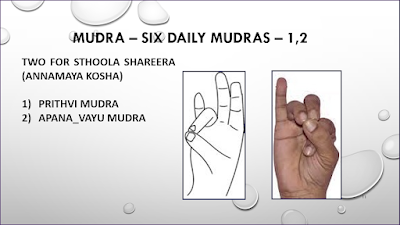
    a) Cleanse the channels(nadi) - Apana Vayu mudra
    b) Strengthen the Prithvi connect - Prithvi mudra 
    c) Enhance the flow of prana through the channels(nadi) - Prana Mudra

    2) 3 Mudras for Spiritual Body -
    a) Cleanse the channels first - Shunya Vayu mudra
    b) Let the knowledge flow - Jnana Mudra
    c) Gently coax the body into meditation - Dhyana Mudra

    Look at all your extremities - scalp, eyes ears, nose-tip, lips, finger and toe tips -

    Regular exercise for sense organ endings - all age groups -

    1) roll your tongue - 10 times clockwise, anti clockwise
    2) massage with index fingers both sides - mouth, nose ears, eyes, palms
    3) ears - massage, twist, bend
    4) eyes - massage on all sides
    5) nose tip - pragna chakra
    6) fingers, toes, palm, feet micro circulation
    7) If possible, bend your head down and start combing touching all the points on your scalp. If not, find a partner and do it for each other or simply go to a parlor for a head massage once a week.

    Specially for the Elderly - can be practised any time. Minimum 10 minutes with concentration on breath for mudras.
    1) Tap on head
    2) Hand preparation - palm on palm, web press, finger tips, back of palm, sides of Palm, twist wrist and fingers
    3) eye points - Eyebrow corners, below eye - tap tap tap
    4) nose points - both bases at nose tip
    5) chin point - chin centre
    6) side of thighs - tap the sides of the thigh
    7) ear points - behind ear massage, press and release ear from the base to the top of the ear for instant energy
    8) pinch from behind ankle upwards - Urinary Bladder healing
    9) massage back of neck - press and push skin from sideways
    10) massage knee - press and push skin from all around
    11) micro circulation of fingers and toes
    12) space element high for elderly - so body parameters different everyday - but mind can be tackled to heal self
    13) mudras - 6 daily
    14) sara sara mudra - vulcan symbol (fingers separated at the centre) - arthritis healed 
    15) visha-hara mudra - same as above + place thumb at the base of ring finger side as if feeling pulse in ring finger - helps detoxify body
    16) kailash mudra if no BP - thumbs up with right hand, place the top-like tip on the left palm - dead cells wither away 
    17) varuna mudra - water balance
    18) meow mudra - BP
    19) block removal mudra - criss-cross fingers and stretch thumbs out at chest level
    20) ganapa mudra - cup hands at chest level and yank - good for lungs, shoulders, harmony
    21) suchi mudra - both hands fist at chest centre - inhaling stretch index finger out and stretch both hands to the front and sideways making a circle, exhaling back to chest and form fist again - cures constipation, very effective - in half hour, bowel cleansing will happen.
    22) garuda mudra if no BP - 3 levels - interlock thumbs and spread fingers like wings of a bird - spread at lower abdomen level, then at upper abdomen level and finally at chest level.
    23) thumbs merudanda mudra - thumbs up - place on thighs for 10 breaths each round - first round, thumb facing inwards, second round thumbs facing sky, third and final round - thumbs facing outwards.
    24) AUM chanting with 4 mudras - Jnana(Chin) mudra - A, Chinmaya mudra - U, Adi mudra - M and Brahma Mudra - silence.
    25) Sahaj shankha mudra for back pain and activating 10 nadis in the body - interlock all fingers and place thumbs parallel to each other on interlocked fingers and hold at convenient level.
    26) Urinary leakage cure - interlock pinky fingers with force and release 10-20 times twice a day.

    Saturday, July 30, 2022

    Pancha-Agni - an insight


    Source: https://sanskritdocuments.org/sites/giirvaani/giirvaani/nataraja_symbolism/nataraja_symbolism.html


    Eternal Fire

    The left upper hand of the Nataraja idol holds Eternal Fire. He is already surrounded by devastating cosmic fire, then why handling this fire like a torchlight... This handheld fire is the essentail principle of life, with which everything transforms, either biological bodies to ashes, or seawater to raincloud etc. The process called Five-Fire Process, pancha agni vidya stems from this fire alone, which in a rudimentary way is this:

    When humans on earth oblate watery substances like curds, ghee, milk, or at least water for gods, gods receive it and in turn oblate it in the celestial fire, called dyu loka agni, mixing with soma, the nectarious principle. 

    Again when gods oblate that nectarian soma into parjanya agni, fire in raincloud.

    It becomes rain, and showers the same in the fire of earth, bhuumi agni, whereby earth yields food. 

    Then the gods oblate that food in the fire of males, puruSha agni, i.e., they destine males to consume that particular food with nectarian principle in it, which gets transformed as a fruitful seminal fluid in males. 

    And fianlly the same gods oblate the same fruitful fluid, via their fortunate males, in the fire of females called yoShita agni, whereby that soul which originally oblated liquids to gods takes birth as an offspring of that couple. 

    Thus the cycle of birth and death becomes continuous.

    This eternal fire keeps on burning from birth to death, causes Five-Fire Process, and thus it keeps the Universe on its wheel, as such shiva holds it, rather controls it.

    Thursday, May 26, 2022

    Pradakshina and its count elaborated

    How many pradakshinas(circumbulations) one should do around the temple?

    For all and specially for the Panchayatna followers, the rules for pradakshina are as follows:

    एका चंड्या रवे: सप्त, तिर्स्त्र: कार्या विनायके:।
    हरेश्चतस्त्र: कर्तव्या:, शिवस्यार्ध प्रदक्षिणा ।।

    Eka Chandaya Raveh Sapta Tirstra Karya Vinayake||
    Hareschatarstrah Kartabyah Shivasya ardha Pradkshina||

    For Durga(Chandi), one should do 1 pradkshina, 
    for Surya(Ravi) - 7, 
    for Ganesha(Vinayaka) - 3, 
    for Vishnu(Hari) - 4 & 
    for Shiva only 1/2.

    What is half pradakshina?
    Refer to image. The pradakshina should not go beyond the Gomukhi for Shiva. 
    By half pradakshina is meant a "SomaSutra Pradakshina" as stated in the next Sloka:

    Shivam Pradaksini Kurvan Somasutram na Langhayeth, iti Vachanantaraat.

    While doing Shiva Pradakshina the order of Shastras is that one should not break the Somasutra.
    By Somasutra is meant the Half Moon like curve that is traced out in the process.

    More on somasookta pradakshina - the reason behind this odd form of pradakshinam, then here it is. It is done to commemorate the circumambulation of the Devas around Mt Kailash when they came for help. They kept running between Nandidevar and the poison, denoted respectively by the Nandi mandapam and the gomukhi, in a similar fashion until Shiva decided to sort things out. The Somasooktha pradakshinam is infact a re-enactment of the devas pleading to Shiva for help.

    More details on this link - https://www.hinduismfacts.org/parikrama/